______________________________________
“…every drop of sun is full of fun and wonder,
You are summer.”
—Nicole Nordeman, Lyrics: “Every Season”

(RAW FOOTAGE FROM MY NOTES, 1992: Summer in my childhood “….the complete joy of contemplating a long three months of carefree frolicking, fishing, and swimming in the gravel pit. How the summer flew by: haying, the dust and thirst of it, driving the team and wagon for the first time, unloading the loose hay in the enormous loft…. Running barefoot, the soles of our feet as tough as the shoe leather they replaced, through pastures and woods, herding home the cows at milking time…..”)
Several times a week during the summer months, we enjoyed homemade ice cream, swirled to a stiff texture with the hand-cranked freezer packed with ice crushed from the heavy blocks we had stored in thick layers of sawdust in the sunken ice house during the previous winter. And salt. Homemade ice cream will not harden unless the freezer ice is liberally laced with salt. But the real treat for us was “boughten” ice cream, which we had once in a blue moon, and then only if we were good. Every two weeks, on Fridays, the Maple Leaf Brand ice cream truck pulled hopefully into our drive, usually only to be waved away with a “nothing today, thanks.” Once in a great while, Dad would buy a cardboard carton of half a gallon of Vanilla or Maple Walnut flavored ice cream. We would feast on the spot because we had no freezer to keep it hard.
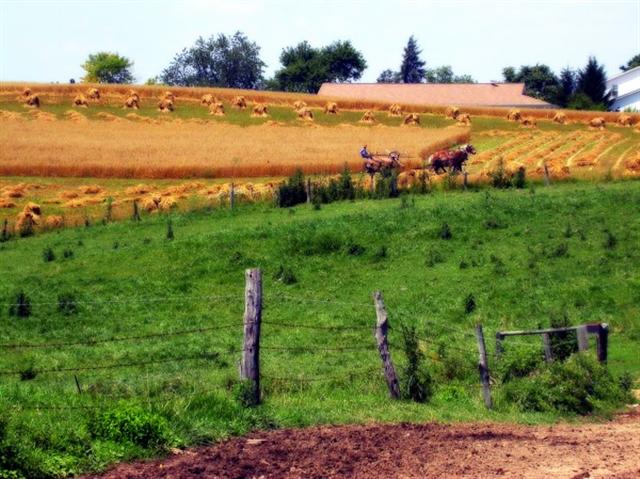
One day in late July, my brothers and I were laboring in the field, setting up shocks with the heavy-headed sheaves of oats that lay sprawled across an endless sea of gold. It was labor-intensive, itchy, brutal work. The sheaves had been spit from the clattering reaper/binder earlier in the day, neatly tied up in bundles and deposited in long irregular rows across the field. The binder was a complicated contraption con-sisting of blade and platform and a confounding array of canvas stretched on rollers. It had a great wooden paddle with five or six slats (not unlike a steamboat paddle) that forced the oat stalks into the teeth of the blade and onto the platform. It always made a great, awful clamor when in operation, the whirl of canvas, the wicked clicking of the blade, the hoarse shouts of the driver (one of my older brothers) urging on his three-horse team. To watch it in operation was to witness the combined rhythm of ancient machine and raw, straining muscle power.

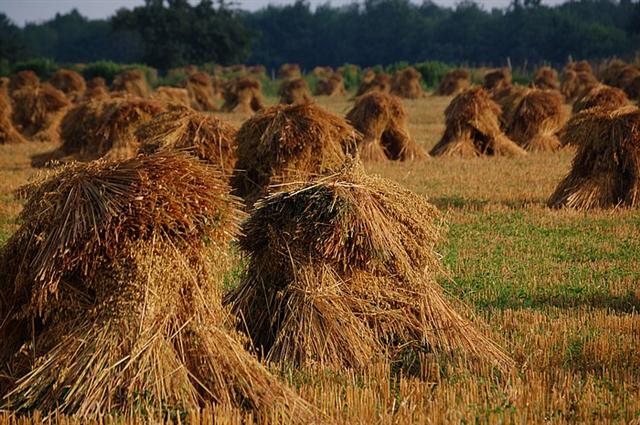
Probably since long before Cyrus McCormick invented the reaper more than a hundred and fifty years ago, the method of tent-shocking oats and wheat has remained un-changed. First, one takes two sheaves and places them together, slanted toward each other at the top. Placed so the dry south winds can whisper through. Then four more sheaves surround the two, then two more on the outside of the four. Finally, one last sheaf, the head, is taken, the heads of grain on the top fanned out, and laid across the top of the others, facing to the west. To fend off the rain. I have seen such grain shocks endure the most savage rain storms imaginable and dry naturally with a day or two of sunlight and wind.

We were working in the southwest field of my father’s farm. The time: midafternoon. The day: a Friday, oozing with heat. The woods just to the south blocked what breeze there was. We wiped the sweat from our brows and gulped lukewarm water from our jugs. Row upon row of sheaves stretched before us; the finished shocks kept mute watch behind us like silent monuments to our toil. Then one of my brothers, I think it was Joseph, the oldest, his brain stimulated to new heights by thirst and heat, suddenly declared an epiphany. We could flag down the ice cream truck and buy a box of popsicles. His suggestion was instantly greeted with tremendous enthusiasm and shouts of excitement.
A hasty Council, consisting of my four older brothers and me, surrounded by a thou-sand scattered sheaves, assembled in a knot to discuss the plan and its implications. I was delirious at the thought and all for it, not that my opinion mattered much. After some weighty discussion, the decision was made. Now for the money. Two quarters was all it would take. Somehow they materialized from someone’s pockets. Who would go? The Council decided that, as the smallest and the least useful for the actual field work, I would be the chosen one. I was six or seven years old. I couldn’t believe my good fortune. Not only would I savor the rare cold icy joy of delicious popsicles, I would get out of the hard work of shocking oats for the time it took to fetch them.
In solemn ceremony, the Council surrounded me. I was handed the two precious quarters. And given careful instructions.
“Now hurry. He’ll be coming along soon. Make sure you wave him down. So he can see he’s supposed to stop. He’ll stop. Just tell him you want a box of popsicles. You can do it.”
Thus instructed and admonished, clutching the precious quarters, I set off on my little quest across the oats field, a ragged, curly-headed, grimy-faced little boy on a mission. The stubble on the ground crunched beneath my bare feet. I navigated the shortest route through the oats field, stepped carefully through the stickered fence row, scrambled cautiously through a barb-wire fence. Next, a dusty pasture field with cow paths worn and ribboned throughout, the screeching of the killdeers falsely dragging one wing along the ground, faking injury to lead me from their nests of eggs or hidden young. Excited and nervous, I finally reached the dusty graveled road. There I waited in the sun.
The spot I chose to wait was just a few feet west of the crossroads leading north the quarter mile or so to Pathway Publishers, the print shop and offices where my father worked and wrote, and down the small sloping hill just east of our neighbor John’s place. Some concern had been expressed by the Council that my father might just happen to glance out his office window, discern the plot and crush our hopes with a stern wave of his mighty hand. Worse, he might decide, as was his wont at any hour, to leave the office and head for home in his rattletrap topbuggy, right past me. If that happened, he would no doubt be very curious as to why his small son was standing hatless beside the road, clutching two quarters and peering intently toward the west. An investigation would ensue. Questions asked. It would be awkward and would almost surely result in no popsicles for anybody. But the heat of the day was too high and the thirst for relief too deep; the reward would be worth the risk. Deliberately ignoring the north and my father’s frowning office window, I scanned the western horizon of the road. As each cloud of rising dust announced an approaching vehicle, I strained to see if it was the ice cream truck.
A car passed. Another. A pickup. Each time, the dust rose and rolled by in great choking clouds, then settled. Minutes passed. Then I saw it coming, the red pickup with the refrigerated white box on the back with the Maple Leaf logo. Half doubtful that the scheme would actually work, I stepped onto the road and, with all the authority of my seven years, firmly waved my right arm up and down with all the confidence I could muster. Stop. The truck approached. Slowed. Slid smoothly to a halt beside me on the crunching gravel.
The “Ice Cream Man,” as we called him, was a tall thin man with a harelip. He wore a hat and dark blue uniform and talked sideways from his mouth. A worn black leather money pouch with a flap nestled comfortably on his hip, diagonally strapped across his body over the opposite shoulder. He got out of the truck and greeted me cheerfully, as if he stopped for waving little Amish boys every day. So far, so good. A hurried glance in all directions; no cars approached. No buggies either. Good. All I had to do now was forge ahead.
“A box of popsicles, different flavors” I said bravely.
With far more dignity and cheer than was warranted by such a pitiful sale to such a raggedy customer on such a dusty road on such a brutally hot day, he unlatched and opened the freezer door. Great clouds of frost billowed out into the summer heat. He rummaged for a moment, then handed me a box of ten popsicles, assorted flavors. He closed the freezer door with a solid thunk.
“Fifty cents,” he said. I held out a grubby hand and he carefully plucked the quarters from my fingers.
“Thank you,” he said. I repeated the phrase back to him. The transaction was com-plete. The sense of accomplishment from all the trade conducted by powerful men in the gilded halls of commerce in all the far great cities of the world could not have matched the swell of pride and happiness that surged through me as I turned in triumph toward the fields.
Holding tightly onto my now-melting treasure, I raced back to where my brothers waited expectantly and eagerly. I was the smallest, but right now I was the most important. Five of us. Ten popsicles. Two each. Work ceased. We sprawled among the shocks and feasted on icy fruit. We were kings. And my father never knew.
________________________________________________________________________
Of the five books purchased as described in my last blog, I am the most pleasantly surprised by “The Complete Shorter Fiction of Virginia Woolf.” I have read the first three or four stories and almost immediately upon beginning the first one, stopped and said to myself, “This is really, really great stuff.” She writes with taut and total control, but with vivid and flowing description. I see her influence on Thomas Wolfe, who was born in 1900. He must have read her works in his childhood and later. I think they must have known each other. Wolfe is more descriptive, but far, far less controlled. I am delighted to have discovered another friend.
I have a confession. I have just subscribed to the New York Times Review of Books. No, I have not crosssed to the dark side. I depise the NY Times newspaper, but the Review of Books is a separate entity, quite in-depth and very interesting. All right, all right. It’s a bit highbrowed, and lofty too. And definitely liberal (or progressive, or whatever it’s called these days), some articles almost unbearably so. I won’t expect to read any reviews on books by my favorite conservative authors or any reviews written by them. But it’s an outstanding read nonetheless. An artist friend of mine always has several issues strewn about the house when I stop by, and each time I pick one up and become completely engrossed. Last time that happened, about a month ago, I decided to subscribe for myself. My first issue arrived this week and I’m perusing it with great enjoyment.
My friend Allan Stanley stopped by for a cookout Sunday evening. Allan and I go way back; I think I met him in 1989 when I first came to Lancaster County. We struck it off almost immediately after we met and have been close friends ever since. He traditionally stops by Sunday evenings several times a summer, and I cook out. We had a special treat this time, bear sausage. One of my friends recently shot a bear in Canada and gave me several packs of sausage. It pays to have connections. The meat is quite tasty, and just a bit sweet. This batch had a hint of Liverwurst flavor, I thought (and no, I am not a wine critic). Maybe it was from the pork or beef mixed in by the butcher.
Thanks to Ray and Maggie (my sister) Marner for the box of outstanding goodies. Thanks, Sis. The tarts will provide my breakfasts for a month.
HAPPY BIRTHDAY, JANICE!!!!! Love you. Can we all come to the party?

YOU ARE WELCOME TO POST A COMMENT ON THE LINK ON THIS PAGE ONLY.
______________________
“Play us a tune on an unbroken spinet, and let the bells ring, let the bells ring! Play music now……Do not make echoes of forgotten time, do not strike music from old broken keys, do not make ghosts with faded tinklings on the yellowed board; but play us a tune on an unbroken spinet……let us see Mozart playing in the parlor, and let us hear the sound of the ladies’ voices. But more than that; waken the turmoil of forgotten streets, let us hear their sounds again unmuted, and unchanged by time, throw the light of Wednesday morning on the Third Crusade, and let us see Athens on an average day. Let us hear the sound of the voices of the Greeks, and observe closely if they were all wise and beautiful…..”
—Thomas Wolfe
Last Saturday, while passing through Morgantown, I decided on a whim to visit an old favorite haunt, the Walter Amos Bookstore. It’s located in a bedraggled old strip mall with a deteriorating parking lot. The day was hot and muggy and the pavement’s heat shimmered up in palpable waves as I got out of my truck. As I walked up to the store, I was greeted by large signs posted all over the front: Going Out of Business. All Books 75% Off. My mind briefly rejoiced at this unexpected chance to peruse for bargains. But I also almost immediately felt a deep stirring of nostalgia and sadness, knowing I would not come this way again.
The bookstore and I go way back. In the early 1990s, during the summers when I was back from college, I boarded with Ben and Emma Stoltzfus on their farm along Rt. 10 just outside Honey Brook. The bookstore was a weekly haunt. My normal Saturday started at the greasy spoon, Polly’s Restaurant, where I shoveled down vast quantities of wheat toast, over-medium eggs, home fries well done and great crisp slabs of fried scrapple covered with ketchup, despite the server’s efforts to get me to use syrup instead. (Why anyone would pour syrup on scrapple remains a mystery to me.) Lean, and solid everywhere, I packed it away with no thought of calories, fat or other unhealthy after effects. After savoring the last drops of coffee and finishing the morning newspaper, I always ambled unhurriedly across the parking lot in the rising heat to my real destination, the bookstore. The place was fairly large, and dimly lit; there were no windows to interupt the shelving along the walls. It was like an enchanted cave with a forest of bookshelves. And all the shelves sagged with books. Every type, every subject. Most of my time was spent in the literature section, savoring the atmosphere for hours, usually ending up with one or two more books. Sometimes I forgot I had a copy of a particular novel and bought it again. It didn’t matter; it was a book.
The Old Testament somewhere describes a city that had walls so wide that two chariots could be driven side by side on its surface at the top. At Walter Amos, the aisles between the shelves were so narrow that two people could not pass each other without saying “excuse me.” Those with ill manners could not have survived long in the labyrinth. Old Walter Amos himself managed the store back then. A spry elderly man with close-cropped white hair, his body erect and thin, wire-rimmed glasses perched on his nose, he was a fixture behind his desk, just to the right when you walked through the front door. His desk was always surrounded by piles and stacks and boxes of fresh arrivals as he pored through the thick price indices, laboriously marking his price inside the front cover of each book with a pencil. One summer, when I returned, he was gone. I didn’t ask at the shop, but a friend told me he had died. His long-haired, pony tailed, tattooed biker son sat in his stead. The son was actually friendlier than the old man, but it seemed to me that he did not know his craft as well or love his books as deeply as his father had.
I walk in. Complete disarray. Half the bookshelves are gone. Workmen putter and stomp about, tugging on other half-tilting shelves. More shelves are being uprooted. A few still remain where they have always been, half loaded with books. An angular-faced middle-aged lady sits sternly behind the counter at Walter’s desk. She wears glasses. His daughter. Has to be. She smiles and greets me. I wonder what happened to the tattooed biker son. Maybe he died too. Most likely got killed on his bike. I don’t know. I turn left around the corner to the literature section. What had always been a proud display of fifty feet of floor-to-ceiling shelving loaded with books is now a partial section on which huddles a forlorn little group of lonely books. I walk to them as I would approach a wounded friend.
Wolfe is gone. So are Wodehouse, Hugo, Faulkner, Joyce, Sinclair Lewis and Ayn Rand. Tolstoy and most of the other Russians. And a host of others. A few tattered Dickens titles still loiter hopefully. And Maugham. Shakespeare too. Haven’t read him much since college. I scan the titles, taking my time. Now is the time to buy at this price.
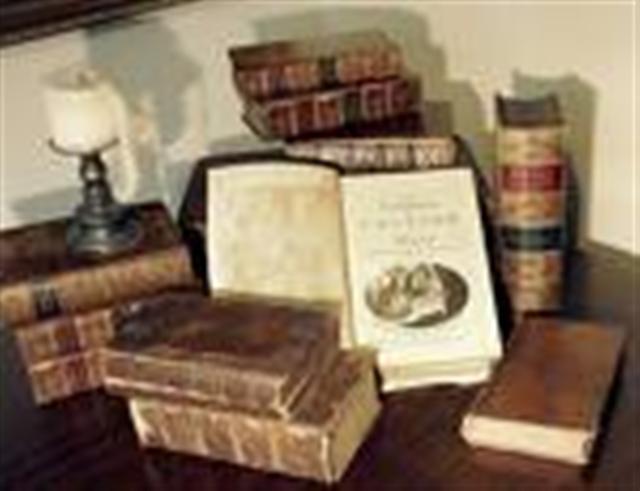
On those Saturdays, I invaded the place and time was of no consequence and the world was mine. I was young, in school, broke (respectfully so, since I was a student), and in the prime of my passion and strength and hope and discovery of all things new that the University can offer. Sometimes I bought volumes just to own them because they felt good. Sometimes I bought them just so I could say I owned this or that title. I bought a beautiful five-volume set of leather bound, ribbed-spined books, a hundred years old, written by some obscure and now completely forgotten author. I never read them; I don’t think anyone else ever had either. They were in mint condtion. Twenty bucks for the set. I still own them. I bought a complete set of the Great Books, nicely packaged in a two-shelf case. It set me back $120.00, a fortune in those days. (Years later I acquired an almost new set of Great Books and gave my old set, sans shelf, to a nephew. Reuben Wagler, are you there? I trust you’ve read them all.) My treasures were carefully lugged home and up to my little attic loft at the peak of the farm house. Where I devoured them, or to be more accurate, parts of them. I tore through great chunks of words, absorbing some, skimming some, feeding on a section of one book here, setting it aside and seizing another. My bedside stand was often littered with a half a dozen books stacked about, opened face down. (Ben and Emma can tell you. I suspect that Emma often secretly despaired at my book-cluttered loft.) A lot of chaff flowed through my hungry mind. A lot of good stuff, too.
I sift through the remnants of the wreckage slowly, scanning all the books, making sure I don’t miss a treasure. A paperback of short stories by F. Scott and Zelda Fitzgerald. I hadn’t known they collaborated in their writing. I set it aside, starting my stack. Another book, a biography of Proust, catches my eye. A hefty paperback. Proust. I’ve always gathered from the horsey, blue blood set, at least the few that deigned to acknowledge my existence, that one wasn’t well read until one had read Proust. And could discuss him with the appropriate opinions. With a spot of tea, perhaps. And a biscuit. Or a crumpet. Would a bio count? I place it on the stack. Years ago I bought Proust’s “Cities of the Plain” in two volumes and “Swann’s Way.” I did read about a dozen chunks throughout, but could not discipline myself to actually read carefully through the whole thing. The Frenchman flits about like a butterfly, following great flights of fancy and remembrance, triggered by something as simple as a single sip of tea and crumbs, the taste of which transports him in his mind to vast store-houses of memory and imagination.
The store always had several tables outside, loaded with cheap paperbacks. I don’t think the owners would have cared had someone just walked away with the lot, and maybe the tables too. One sunny and cloud-tossed Saturday, as I stood there, sifting aimlessly through boxes of outdated titles, I heard the abrupt, gutteral rasp of a strange and frenzied grunt. It took a few seconds for my startled eyes to register to my brain that a stout elderly heavy-set gentleman with a cane had stumbled and fallen on the sidewalk. He was poorly clad in Goodwill-type kakis and wore a cheap little fedora and stared up at me helplessly through thick plastic-framed glasses. He lay there on his side like a log. He couldn’t move or get up. “Help me,” he said matter-of-factly. His stubby hand reached out, rotating in small circles as he strained to reach me. Seconds passed. Then my frozen muscles emerged from paralysis. I moved toward him and in one swift motion grasped his hand and heaved him to his feet. He thanked me briefly and very simply. I could not look him in the eyes; so deeply did I feel his shattered dignity. He hobbled away, his cane thumping quietly and solidly on the sidewalk. I never forgot that incident. It seared into my brain the horrors of daily life for one old man I never saw before or since.
I browse some more. A very good quality, hard cover copy of Virginia Woolf’s shorter fiction. I’ve never had much exposure to her. I page through it, glance at the story titles. I add it to the stack. I wonder why the store is closing up, but then again, I know. It can’t survive. Not in the age of the Internet. People just don’t go book shopping like they used to. Oh, well. Market forces and all that. Ayn Rand taught me. I know how it works. If you can’t survive, you shouldn’t exist. Not in business. Besides, people read other things now. Like blogs. Others write them. But still, it’s sad. Not kind of sad, but sad.
I must go. I quickly tour the remains of the shop. In the humor section, I discover a practically brand new copy of “The Bachelor Home Companion,” by P.J. O’Rourke. It should fit my home décor about now. I glance through it. Add it to the stack. And one more humor book by O’Rourke. I pass through the literature section one last time and linger there for a moment. My stack now totals five. Three paperbacks. Two hard-covers. I approach and pay the angular-faced lady six dollars and twenty-three cents. There is a groaning screech of protest, the sound of wood and nails parting, as the workmen uproot another bookshelf with their pry bars. “Do you want a bag?” she asks politely. “Please,” I reply.
In 1990, during my second full year as a student at Vincennes University, I developed a close friendship with a girl, a fiery liberal with fiery red hair. We had little in common, but respected each other and hung out a lot and discussed many things. Sometimes we both had to bite our tongues and just shut up. She appreciated books and was fascinated by my somewhat uncontrolled and exuberant enthusiasm for all things written. That year I read “War and Peace” and it was not a class requirement. She was amused and snapped a picture of me reading the book. I had not yet discovered Wolfe.
One evening she invited me to her dorm room (I lived off campus.). She had a movie, she said, that I really needed to see. I trusted her judgment enough to go, with some reservations. It was a movie about books, and the twenty-year correspondence and deepening friendship of an American lady who loved old books and a stodgy English bookseller in London who shipped them to her. Anne Bancroft and Anthony Hopkins play the lead roles. The movie ranks right up there as one of the ten best I’ve ever seen. The title: “84 Charing Cross Road.”
________________________________________________________________________
The summer heat has finally been unleashed. Only two weeks ago, during a short heat spell, I installed my two window air conditioners. One in the bedroom and one in the kitchen. Since then they have had sporadic use. But the last few days they have been humming. And so will my electic bill.
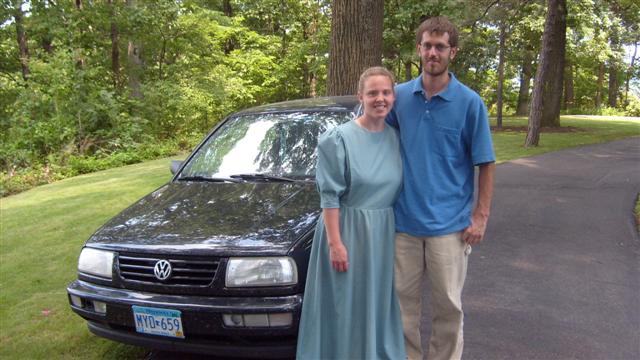
Last Sunday, I dined at Steves again. Seems like I am a very frequent presence at their Sunday table. Jason and Julie Yutzy from MN were there as well. Jason teaches school in his community in MN and they are at Faith Builders in Meadeville, PA for some teaching courses. So they made the 5 hour trip down to visit relatives and headed back to Meadeville on Sunday afternoon. To do penance for my slam at his VW, I took a photo of them and it. Sharp little car; I had envisioned one of those little 1980s Rabbits for some reason. This time, this one got them here and back.
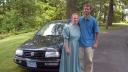
Jason and Julie and the little VW that could
On Monday evening, my mechanically proficient friend Paul Zook stopped by to check out my clothes dryer, which has developed a loud, obnoxious squeal. Just back from the gym, I was eating when he arrived. “No problem,” he said and went to work with the tools he’d brought with him. In less than ten minutes, the dryer lay in pieces, completely dismantled on my laundry room floor. Paul discovered the problem; a plastic bushing had deteriorated and metal was now rubbing metal where it wasn’t supposed to. Of course, we had no way to fix or replace the bushing, so Paul oiled and cleaned everything and deftly assembled the whole thing again in less time than it takes me to write three paragraphs. I offered him a cold cherry soda, and we sat around and shot the bull for half an hour. He then bustled off, carrying a can of Superfood that I forced on him for his efforts.
FOR KALI…WE PRAY TO THE LORD…..
OH LORD, HEAR OUR PRAYER…..

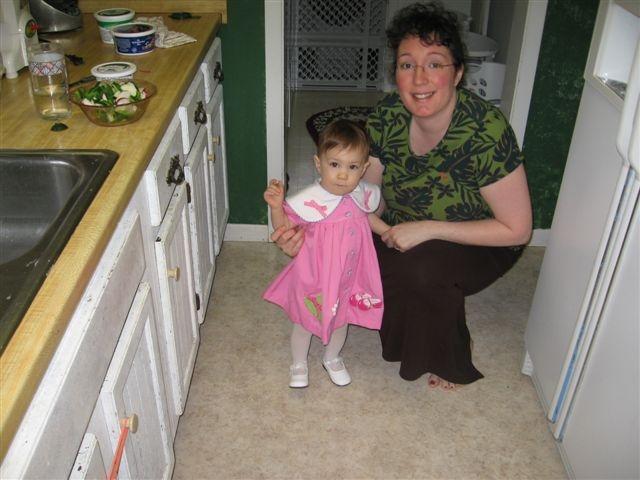
Mother and daughter. Dorothy and Kali
YOU ARE WELCOME TO POST A COMMENT ON THE LINK ON THIS PAGE ONLY.